


The business world is blurred by AI-generated content and overnight experts all claiming to be the best, and credibility has become the new trust currency. Consumers are becoming more and more sceptical, and if you want to be known, liked and trusted, it's becoming vital that you provide evidence to validate your expertise and leadership.
This is where the power of business awards comes in.
A reputable award acts as a potent third-party credibility factor that elevates your brand above the noise, providing tangible proof that a standard social media post simply can’t match.
Many mistakenly consider awards to be a one-off vanity exercise, but they can be the ultimate trust signal to your ideal audience. When you integrate awards into your digital approach, you create a cascade of high-authority content that removes hesitation and transforms your brand into an irresistible industry leader.
In order to not only successfully submit a winning entry, but to maximise your entire awards journey, you need to understand the craft of award writing.
What is business award writing?
Business award writing is quite different from grant writing or copywriting. It’s a strategic process of documenting your achievements, innovations, and impact to meet specific judging criteria while also crafting evidence-based narratives that weave data and case studies into your story. Rather than a marketing opportunity, award entries position you and your brand as a credible leader in the minds of the judges.
Effective award writing moves beyond simple storytelling to focus on the metrics that matter. It requires a deep dive into your purpose to identify a Unique Profile Position (UPP), which defines what you want to be known for. This ensures that every submission aligns with long-term brand goals rather than serving as a one-off attempt to pick up a trophy.
Imposter syndrome often discourages self-promotion and holds people back from entering awards. Once you discover the many award programs that enable start-ups, scale-ups, innovators and thought-leaders to enter, you realise there is definitely a place for you.
Professional award writing can also act as a reliable bridge to gain visibility on your achievements, giving you the time to reflect on where you have come from and where you are going. When you focus on the evidence, such as sales figures, growth data, and impact, you demonstrate your worth without relying on empty claims, and you realise how much you have actually achieved and the legacy you are creating.
Crafting your entry and submitting it is only part of the process, though. You need to make sure you leverage it in order to be seen and noticed, building a credible profile as an industry-recognised leader. And you shouldn’t wait to see if you win before repurposing it.

How do you leverage a business award entry?
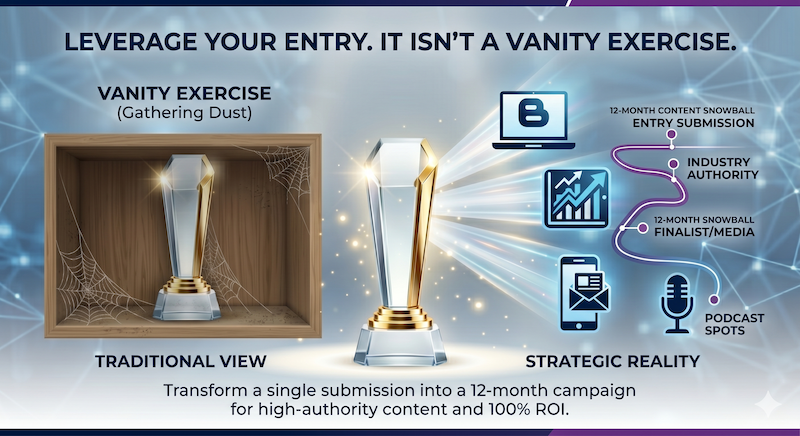
Award leveraging is the practice of taking the awesome content you just slaved over to create your award submission into marketing assets like blogs, social media posts, EDM’s and articles. This ensures a 100% return on investment from the moment of submission, regardless of whether you reach finalist status or win the award.
The strategy involves a snowball effect model where the award entry serves as the foundation for a 12-month content calendar. By breaking down an entry into monthly themes, you can create consistent brand awareness that resonates with peers and industry leaders. This approach eliminates the frustration of wasted effort often found in traditional PR pitching.
For example, successful innovators might use their submission data to secure media contributorships and podcast appearances. This snowball effect builds momentum and trust, transforming a single award entry into a multi-channel profile-building campaign.
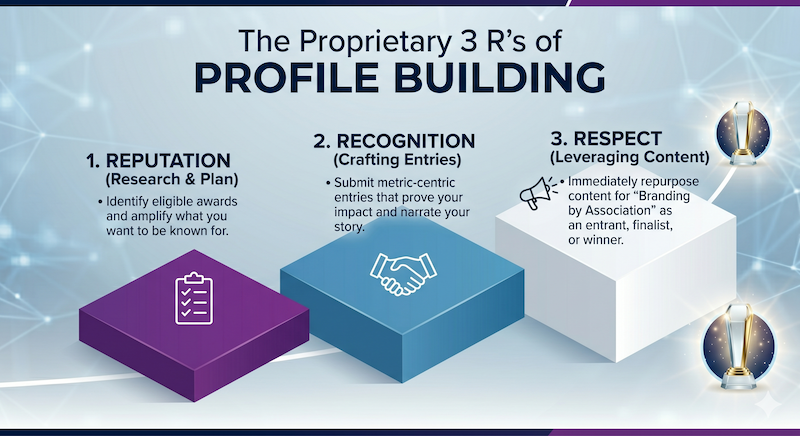
What are the 3 R's of profile building?
The 3 R's is a proprietary strategic process consisting of Reputation, Recognition, and Respect. It begins by identifying why you want to build your reputation, followed by submitting compelling entries for recognition, and finally leveraging that content to earn long-term respect and industry authority.
How do awards impact business growth and credibility?
Awards provide tangible third-party validation of quality and expertise even before someone has worked with you. They act as a potent credibility factor in crowded markets, especially if you sell intangible services or online products where trust needs to be earned before someone buys from you. They’ve been shown to reduce client churn by up to 56% and increase active subscription clients by 166% when used as part of a long-term profile-building strategy.
Beyond the trophy, awards help entrepreneurs and change-makers who have unique approaches and are impacting their sector, with the boldness to overcome imposter syndrome and stand up to the pressure to play small. Credibility gained through reputable programs such as the Stevie, Globee, or Titan Awards signals to a sceptical audience that a brand is verifiable and expert.
Feedback from clients that The Audacious Agency has worked with shows that award-winning status accelerates growth. One startup secured five major awards and two finalist placements in 8 months, contributing to a client growth rate of 217% and a portfolio value of $91 million. Another leveraged an international win to secure national distribution in pharmacies and online retailers. More talk about how the awards opened doors to joint ventures, funding and partnerships, and others have seen their sales cycle slashed to days instead of weeks, all because of the trusted reputation gained as an awards winner.

What makes an award entry successful?
A successful award entry relies on showing the judges, not just telling them. When you follow the P.R.O approach, it ensures you move from marketing lingo to award-winning conciseness and compelling content that clearly demonstrates your award worthiness to the judges.
P = problem - outlining for the judges why your business exists and the issue in the industry or sector.
R = resolution - outlining your unique approach, method or system to solve the problems and how you lead or innovate
O = outcome, providing those valuable testimonials, reviews and case studies, giving the judges the impact statements they need to see that you are getting results, overcoming challenges or making an impact.
Your entry must align with the judging criteria, provide background for the judges to easily understand your purpose and demonstrate how you handled challenges and achieved results rather than just presenting financials.
Judges look for the metrics that matter and outline impact. You’ll need to set aside time to gather evidence, such as sales figures, innovation data, and conduct direct client interviews or get case studies.
Successful entries often highlight the pioneering spirit of an entrepreneur or innovator or they convey the journey and the ability of an individual or team to solve complex problems or make social impacts. High-quality submissions also include professional support documents and scripts for video components to ensure a polished and authoritative presentation.
Yes, you can use AI, but you should never simply copy and paste content; you need to write your entry, adding in your personality and making sure you remove any jargon or verbose language. We suggest you use AI to brain dump your evidence to help draw out the vital information or metrics, then craft your entry around the best answer to the questions.
A tip to manage word count is to use contractions - I’ve instead of I have, or We’re instead of we are…and you should never type directly into the awards portal. Craft your entry in a document, edit it, check grammar, check the word count and get another person to read through it, before you copy and paste into the portal. There is nothing worse than entering your data, and the site drops out or the Wifi stops, and you lose everything!
You should also avoid vanity awards - those that are pay-to-win or lack rigorous judging and may turn up in your email inbox congratulating you even though you never even submitted an entry! These are impossible to leverage and maintain brand integrity.
Comparison: Traditional PR vs. Strategic Award Leveraging
Feature | Traditional PR Pitching | Strategic Award Leveraging |
|---|---|---|
Success Rate | Often as low as 10% | 100% Guaranteed content usage |
Content Lifecycle | Reactive and short-term | 12-month snowball effect |
Credibility Source | Media mention | Industry-judged 3rd-party validation |
Primary Goal | Fleeting visibility | Long-term profile building for years |
Asset Creation | Single use with social sharing | Repurposed into blogs, social, EDM’s, graphics, email footer, LinkedIn header, articles, guest blogging and added to your media kit or speaker one sheet |
Action Steps for Award-Ready Businesses
- 1Define Your UPP: Identify your Unique Profile Position to determine what you want to be known for.
- 2Audit Your Achievements: Gather case studies, sales data, and impact metrics to serve as evidence.
- 3Map the Calendar: Select 12 months of reputable awards and leverage opportunities that align with your brand.
- 4Craft Metric-Centric Entries: Write submissions focused on results and the "how" behind your success.
- 5Execute the Leverage Plan: Repurpose every entry into monthly content themes to build consistent authority.
Authority Bio
Lauren Clemett, known as the Brand Navigator, is an International Award-Winning Personal Branding Specialist and five-time bestselling author with over 30 years of experience in brand management.
As Managing Director of The Audacious Agency, she has submitted over 1,750 award entries with a 97% finalist success rate.
She specialises in neurobranding and helping entrepreneurs overcome self-doubt to become well-known, well-paid, and wanted brand champions.

